
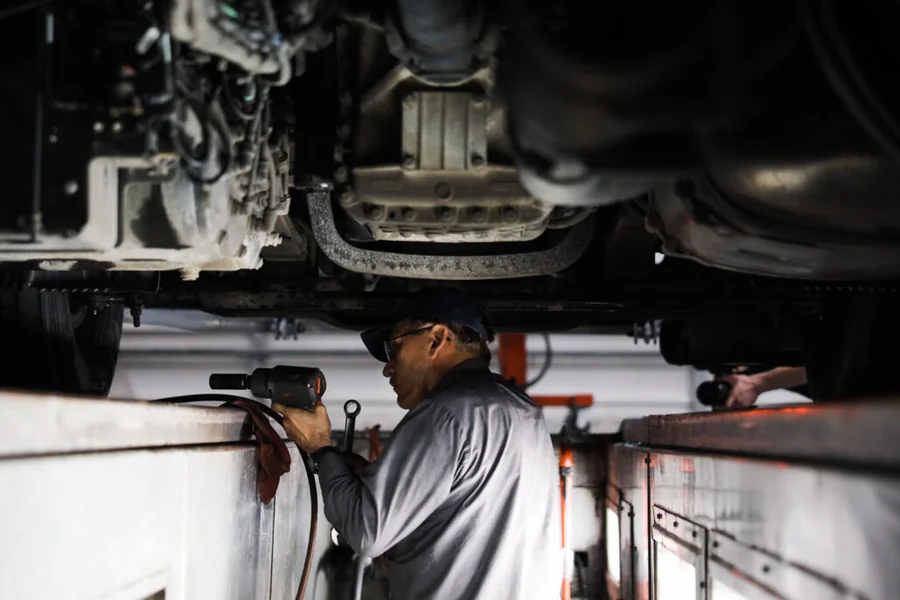
There’s a version of the math that makes deferred truck maintenance look reasonable. You’re behind on a load, the PM is due but nothing feels wrong, and the shop has a two-day backlog. So you run it. And the next time. And the time after that. The truck keeps moving, the loads keep getting delivered, and the maintenance interval keeps sliding. Then something breaks.
What breaks is never just the part that failed. It’s the parts downstream of that failure, the load that didn’t arrive, the driver’s hours that evaporated at a rest stop, the insurance claim that takes three weeks to process, and the customer relationship that gets quietly reassessed. The real cost of ignoring truck maintenance rarely shows up as a single line item. It distributes itself across the operation in ways that are easy to miss until you add them up.
What Deferred Maintenance Actually Costs: The Numbers
The American Transportation Research Institute (ATRI), which tracks commercial trucking costs annually, consistently shows that vehicle repairs and maintenance represent one of the largest variable cost categories for fleets — typically between 12 and 16 cents per mile for Class 8 operations. That’s the baseline for trucks that are maintained. The cost of a truck operating with deferred maintenance isn’t a steady per-mile figure. It spikes, and it spikes in proportion to how long maintenance was deferred.
A few specific examples put the pattern in concrete terms. An oil change on a Class 8 diesel costs roughly $200 to $350 depending on oil type, filter, and labor. A failed engine bearing from running degraded oil — the downstream consequence of a skipped oil change — can cost $8,000 to $25,000 in parts and labor depending on how far the damage progressed before the engine was shut down. That ratio holds across most maintenance categories: the deferred cost is rarely less than 10 times the preventive cost, and often far more.
Brake system maintenance offers another clear illustration. A set of brake linings runs $150 to $300 per axle end. Replacing rotors and drums damaged by metal-on-metal contact — combined with a potential FMCSA out-of-service order and tow to a shop — can exceed $2,000 per axle before lost time is factored in.
Downtime: The Cost That Doesn’t Show Up on a Repair Invoice
Repair bills are the visible part of the deferred maintenance cost. Downtime is the part that doesn’t get invoiced but costs just as much, often more.
ATRI’s research pegs the total cost of truck downtime — driver pay, fixed costs, lost revenue — at roughly $760 to $1,000 per day for a typical Class 8 operation. A roadside breakdown that takes 24 hours to resolve costs an owner-operator roughly $1,000 before the repair bill arrives. Add the repair and the total event cost dwarfs what the deferred service would have cost.
Timing compounds the damage. Trucks don’t break down on schedule. They break down on a Monday in January with a three-day shop backlog, or at 11 PM on a Friday when parts are limited and overtime rates apply. The later a deferred issue is caught, the more likely it is to produce a breakdown in the worst possible place at the worst possible time.
Regulatory and Legal Exposure
Commercial truck operators face a regulatory framework with real financial teeth. The Federal Motor Carrier Safety Administration (FMCSA) sets maintenance standards for all vehicles in interstate commerce, and the Commercial Vehicle Safety Alliance (CVSA) enforces them through roadside inspections that can put a truck out of service on the spot.
During the CVSA’s 2023 International Roadcheck — 72 hours covering over 67,000 inspections across North America — brake violations were the leading cause of vehicle out-of-service orders. An out-of-service citation goes into the carrier’s record in the FMCSA Safety Measurement System (SMS), where a deteriorating score affects insurance rates, freight broker relationships, and can trigger FMCSA operations reviews.
The legal exposure from deferred maintenance in a crash is its own category. Commercial vehicle litigation has escalated substantially over the past decade. When a crash involves a truck with documented maintenance deficiencies — deferred services, ignored fault codes, out-of-date inspection records — those records become evidence of negligence. Nuclear verdicts (jury awards exceeding $10 million) in commercial truck cases have become common enough to reshape the insurance market for large carriers.
Engine and Drivetrain: Where Deferred Maintenance Does the Most Damage
Not all deferred maintenance costs equally. The engine and drivetrain represent the systems where neglect compounds fastest and the repair costs are highest.
Engine Oil and Cooling System
Engine oil degrades over time regardless of mileage. Thermal cycling breaks down the additive package; blowby introduces contaminants; extended drain intervals allow soot loading to thicken viscosity until the oil doesn’t flow properly at cold start. Bearing wear progresses gradually and then accelerates. By the time an oil pressure fault code appears, the damage is done.
Cooling system maintenance is similarly unforgiving. Degraded coolant allows corrosion in internal passages and erodes water pump impellers — a common and entirely preventable failure mode. When the water pump fails in service, the engine overheats. What was a $400 repair becomes a potential head gasket failure, a machine shop visit, and several days of downtime.
Aftertreatment Systems
Post-2010 diesel engines require regular DPF and SCR maintenance. DPF cleaning or replacement runs $1,500 to $3,000 depending on method. The interval at which these services are needed is directly affected by upstream engine condition — worn rings increase oil consumption that loads the DPF faster; injector wear produces incomplete combustion that does the same. Trucks on short local cycles develop DPF loading faster than long-haul units. Scheduled cleaning intervals and engine maintenance that reduces upstream contamination are the primary levers available to control aftertreatment costs. Ignoring them means more forced regen events, more replacements, and more active derate situations.
Tires: The Maintenance Category Operators Most Often Underestimate
Tires run 4 to 6 cents per mile in well-run Class 8 fleets. The difference between a tire program that controls costs and one that doesn’t comes down to discipline: inflation pressure management, alignment checks, and timely replacement of tires at wear limits.
Underinflation is the most destructive thing that happens to commercial truck tires. Running a drive tire at 80% of rated inflation doesn’t reduce service life by 20% — it reduces it by far more, while generating heat that accelerates tread separation risk. A steer tire failure at highway speed is a potential loss-of-control event, which is why FMCSA regulations and CVSA inspectors give steer tire condition specific attention.
Alignment has a direct, calculable cost impact. A steer axle 0.1-degree out of specification can scrub 40,000 miles off a set of steer tires. Those tires cost $500 to $800 each. An alignment check costs less than $200.
The Real Cost of Ignoring Truck Maintenance: A Framework for Thinking About It
The question fleet managers and owner-operators need to ask isn’t “what does this PM cost?” It’s “what does not doing this PM cost, probabilistically, over the next 30,000 miles?” That reframe changes the arithmetic. A $350 oil change isn’t a cost — it’s a hedge against a probability-weighted repair that runs into thousands of dollars and days of downtime.
The operators who manage maintenance costs most effectively treat the PM schedule not as a budget line to minimize but as a risk management tool. They track repair-per-mile costs over time, use telematics fault code data to catch developing issues before they become failures, and understand which failure modes on their specific equipment have the highest downstream cost. That’s not complexity for its own sake. It’s applied arithmetic about where money leaks out of a trucking operation.
When deferred maintenance produces a breakdown — which it reliably does, on a long enough timeline — the response matters almost as much as the failure itself. For operators who need professional heavy duty truck repair and roadside response, getting the truck diagnosed and moving again as fast as possible limits the total event cost. The repair is unavoidable at that point. How quickly it gets resolved is still within the operator’s control, which is why having a reliable service relationship before a breakdown happens is worth more than finding a number at 2 AM on the interstate.
The Real Cost of Ignoring Truck Maintenance: What It Adds Up To
Add the direct repair costs, the downtime costs, the regulatory exposure, and the compounding effect on downstream components, and the real cost of ignoring truck maintenance is rarely hard to calculate — it’s just uncomfortable to face before a failure makes it unavoidable. The PM that gets deferred isn’t saving money. It’s deferring a larger expense and adding a probability premium for the timing and severity of when that expense arrives.
The operators who understand this run their trucks differently. They don’t skip oil changes to make a delivery. They don’t delay brake service because the linings have “a little life left.” They treat the cost of maintenance as the cost of controlling when and how much they spend on repairs, rather than leaving both variables to chance. For breakdowns that happen despite best efforts, professional heavy duty towing and repair response is the mechanism that converts a bad situation into a recoverable one — but it’s not a substitute for the maintenance program that makes those calls less frequent.