
Introduction
In the highly competitive domains of Medical Device Manufacturing or Industrial Equipment Manufacturing, the market window is shrinking with each passing day. Traditional prototyping practices, which often result in costly and time-consuming processes, fail to keep pace with the need for rapid iteration of complex geometries or biocompatible materials during test phases. This is not only affecting innovation but also resulting in substantial financial losses for manufacturers.
This article systematically analyzes how to scientifically select processes—such as CNC machining, 3D printing, or rapid tooling—based on specific verification goals (e.g., functional testing, biocompatibility, pilot production). Through practical case analysis, it demonstrates how strategic process combination and workflow optimization can significantly reduce rapid prototyping cost and accelerate development.
What Are the Primary Verification Objectives in Medical Device and Industrial Equipment Prototype Development?
Design and Functional Verification
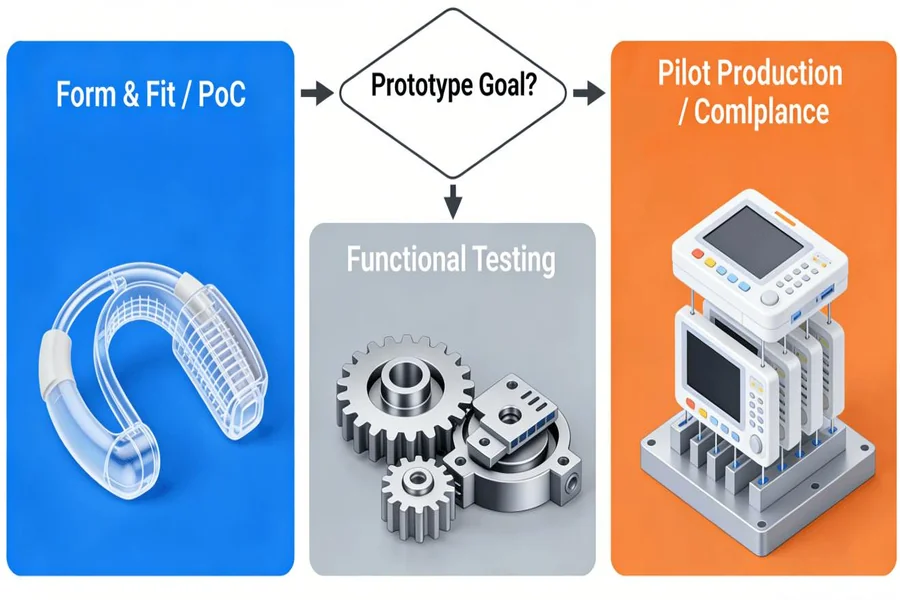
This initial verification phase employs prototypes for the de-risking of core design concepts and performance. In both Medical Device Manufacturing and Industrial Equipment Manufacturing, there is an emphasis on form, fit, and initial functional validation via rapid iterations.
- Proof of Concept (PoC)
This is the initial phase of validation for form, fit, and initial dimensions of the product. Using rapid prototyping applications enables fast iterations of the design, which is important for physical validation of the design, a practice encouraged by the FDA for mitigating future risks.
- Functional and Performance Testing
The prototypes must be subjected to simulated real-world conditions. For the results to be valid, the material used must possess properties similar to the final product, such as strength, resistance to temperature extremes, and biocompatibility for Medical Device Manufacturing in Industrial Equipment Manufacturing.
Compliance and Production Validation
Moving forward, prototypes are useful for rigorous regulatory submission and pre-clinical testing (e.g., ISO 10993), requiring complete traceability of materials and processes. Lastly, for pilot production and feedback from the market, a prototype has to be virtually identical in appearance, performance, and accuracy to the final part, verifying the manufacturing process for Medical Device Manufacturing.
How to Match the Most Cost-Effective Rapid Prototyping Process to Different Verification Goals?
In a scientific approach to match the process with the cost of rapid prototyping, it is necessary to assess quantity, material, and lead time. For low-volume complex concept models, 3d printing for prototyping (SLA/SLS) can be considered for speed and design freedom. For functional prototyping with high accuracy and material properties, CNC rapid prototyping can be considered. This process offers superior material properties. For pilot production with identical parts to production, rapid injection molding prototyping with aluminum tools can be considered at higher quantities. International standards such as ISO/ASTM 52900 are available to guide such a process. A decision tree for choosing the optimal process from the variety of available rapid prototyping services can be created based on quantity, complexity, and material requirements.
What Are the Often-Overlooked Key Strategies for Controlling Rapid Prototype Costs?
Controlling rapid prototyping cost involves more than comparing quotes. Implementing the following strategies during the design and planning phases can prevent unnecessary waste.
Design Optimization is the Source of Cost Control
Conducting a Design for Manufacturability (DFM) analysis before manufacturing is crucial. For Precision Custom Parts, relaxing tolerances on non-critical features and avoiding excessively deep cavities or thin walls can significantly reduce the difficulty and time required for CNC rapid prototyping or rapid sheet metal prototyping, directly saving costs.
Adopt a “Hybrid Process” Strategy
For a complex assembly, not all components require the same high-cost process. Critical load-bearing or moving parts can be made via high-precision CNC, while non-critical housings or brackets can use economical 3D printing or rapid sheet metal prototyping. This combined approach optimizes overall cost while meeting core functional verification needs.
- Material Selection: “Adequate, Not Excessive”
Choose the most cost-effective material that meets the current testing phase’s requirements. For initial functional tests, a lower-cost generic engineering plastic may suffice instead of a premium-grade material.
- Avoid “Over” Finishing
Choose the appropriate post-processing level based on the prototype’s use. Parts for internal fit-check may only need bead blasting, not the time-consuming and expensive high-gloss polishing reserved for market-ready display models.
How to Ensure Rapid Prototypes Support Stringent Industry Certification Requirements?
For rapid prototyping applications in heavily regulated fields like Medical Device Manufacturing, prototype compliance is critical to project success. Ensuring the following three aspects is paramount.
The prototype materials used will require the following certifications for the market segment: ISO 10993 biocompatibility reports, USP Class VI, or UL94 flame retardancy. It is always important to request the full certification documents for the materials from the rapid prototyping services supplier. A good supplier will offer the full history of the process, including the parameters used for the material, the inspection results, and the final inspection. First Article Inspection Reports, dimensional measurement reports, among other documents, are important for the creation of the document trail for the purpose of the following manufacturing, especially for the creation of Precision Custom Parts.
Partnering with a supplier who has relevant industry quality management system certifications is essential. For example, a supplier who serves the medical device industry must have ISO 13485 certification. This normalizes procedures as well as environment , thereby laying a foundation for smooth transfer to production.
Can a Real-World Case Study Show How Rapid Prototyping Drives Project Success?

With the medical startup needing 50 clinical trial housings made from medical-grade ABS within a period of four weeks, they assessed their options. Steel tooling was ruled out as it was both slow and costly. Similarly, CNC rapid prototyping would not only be costly but would also pose aesthetic and assembly difficulties.
The medical startup finally chose rapid injection molding prototyping with aluminum tooling. This allowed for the desired production-grade finish and strength. Moreover, the supplier was able to deliver all the pieces within two weeks at a cost that was 35% lower than CNC machining, thus completing the entire process within more than 40% less time. For further information about complex assemblies, see the JS Precision rapid prototyping case study.
Conclusion
To conclude, a concise overview of how efficient development of medical device and industrial equipment development depends on a thorough understanding and judicious use of rapid prototyping processes. By clearly articulating verification goals, identifying cost-effective processes, managing critical costs, and assuring process compliance, companies can turn prototype development from a speed bump to a speed accelerator.
Working in partnership with a company that has cross-process expertise, rigorous quality processes, and a global footprint of services is critical.
Author Bio
Zoe is an experienced writer with expertise in advanced manufacturing and supply chain optimization. She has over a decade of experience in observation in the industry. She is passionate about delivering insights and strategies for engineers and R&D teams for prototype development and mass production.
FAQs
Q1: What mainly causes a cost overrun during rapid prototyping?
A1: Mainly, design not incorporating manufacturability (DFM) is the reason. It makes the part difficult to machine or requires special fixtures and sometimes extra post-processing. Engaging in a professional DFM analysis before the start of manufacturing is the best method to control costs of rapid prototyping.
Q2: Which one would you prefer for functional prototypes that are to be subjected to high-temperature and high-pressure testing?
A2: In this case, CNC rapid prototyping or metal 3D printing is the ideal option as they can fabricate parts from primary engineering plastics or metals identical to the final product, thus the prototypes can still meet very rigorous test conditions of mechanical properties and temperature resistance and these are the main features that make them the most suitable for functional verification in Industrial Equipment Manufacturing.
Q3: Can one call rapid injection molding cost-effective for small-batch production (say 200 pieces)?
A3: Usually, yes. Even though the initial aluminum mold cost is quite high, distributing this cost over 200 pieces lowers the per-unit cost significantly compared to CNC machining and, at the same time, it provides surface quality and structural strength comparable to mass production. This is a classic scenario of rapid injection molding prototyping advantage.
Q4: How to judge if a rapid prototyping service is a right fit for a medical device project?
A4: Major aspects include their quality system (having ISO 13485 certification is a must), capacity to provide material compliance documentation, and a track record of successful Medical Device Manufacturing prototype projects. Factors such as cleanroom environments and full inspection reports can also be significant indicators.
Q5: Can 3D printing be used to make precision parts for final assembly?
A5: There are a lot of variables such as chosen material and technology. The most suitable being resin or nylon 3D printing for non-load-bearing assembly verification with non-critical tolerances.