

Introduction: Why Research with AI Feels Like a Relief, Not a Shortcut
Research with AI has quietly become one of the most practical changes in how people study, analyze, and make decisions today. Not that researchers have stopped thinking, but because modern research has become heavier, faster, and more demanding than at any other time before.
If ever you have begun a research task with energy and curiosity only to find yourself lost after opening dozens of tabs then you already understand the problem. Information is everywhere. Insight is not.
This is where TeraBox Deep Research and other AI tools stop seeming like tech and start looking like a super quick AI scholar helping you out. Right from the start, it lets you set up thoughts, look more into subjects, and keep your mind on getting meaning rather than nonstop hunting.
This guide will show you exactly how to use AI for research practically, so you will be working smarter and not harder while still coming up with high-quality, meaningful results.
Understanding How AI Can Be Your Research Partner
Moving Beyond the Fear of “Replacing Human Thinking”
When people first hear about AI in research, a common concern appears: Will this replace real thinking?
In practice, the opposite is true.
AI finds its best use when not applied as a decider but as a parallel researcher. It aids in tasks that typically bog humans down such as:
- scanning large volumes of material
- identifying recurring themes
- organizing information into clear sections
This frees researchers to focus on interpretation, judgment, and originality.
What an AI Researcher Actually Does Well
A good AI researcher is especially strong at early and middle stages of research:
- exploring background information
- summarizing complex topics
- highlighting relationships between ideas
Instead of replacing effort, it redirects effort toward higher-value thinking.
Why Academic AI Is Becoming Normal, Not Controversial
In academic settings, expectations keep rising. Students are asked to:
- reference more sources
- demonstrate deeper understanding
- maintain clear structure
Using academic AI responsibly is now closer to using a calculator in math or reference software in writing, it’s a tool that supports accuracy and efficiency.
Getting Your Research Question Ready for AI
Why Clear Questions Matter More Than the Tool Itself
A common mistake when doing research with AI is to begin too broadly. Yes, indeed AI tools are powerful, but they work best under guidance.
Before using TeraBox Deep Research, it helps to ask yourself:
- What exactly am I trying to understand?
- Is this exploratory or analytical research?
- Do I need background, depth, or comparison?
Clear intent leads to clearer output.
Turning a Vague Topic into a Strong Research Prompt
Instead of:
“AI in education”
Try:
- “How AI tools are changing assessment methods in higher education”
- “Benefits and limitations of academic AI in university research”
This small shift dramatically improves results.
Letting AI Help Refine Your Research Question
A highly practical way to use AI in research is to let it assist in shaping your questions. You can ask the AI to:
- Clarify or refine your initial question for better focus
- Suggest related sub-topics you might not have considered
- Identify gaps or perspectives you may have overlooked
It works great for newbies because it leads the research process, gives more exact results, and makes the whole work easier and better.
Your Step-by-Step Plan with TeraBox Deep Research
Step 1 – Define Your Goal Clearly
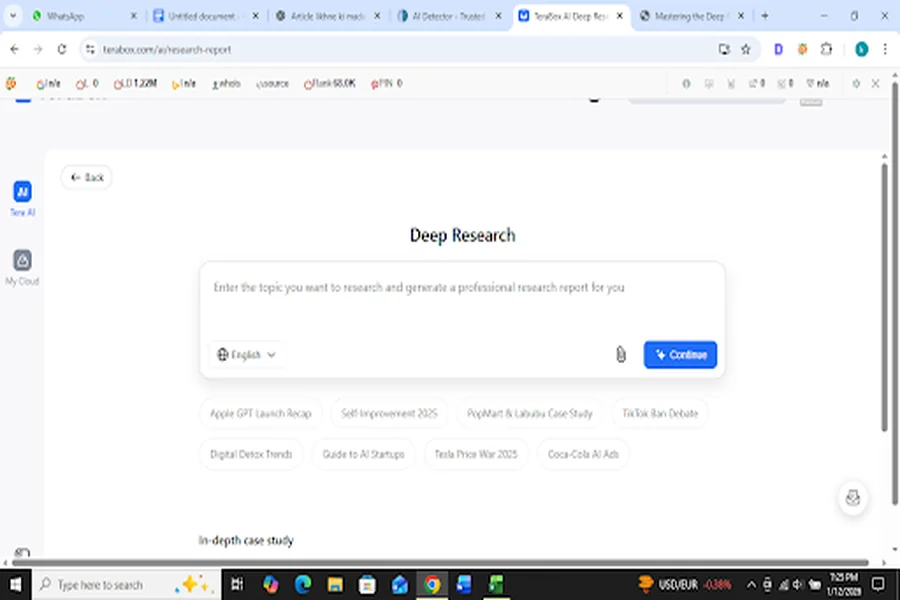
Start by identifying whether your research needs:
- explanation
- comparison
- deep analysis
TeraBox Deep Research performs best when the goal is clear.
Step 2 – Provide Context and Input
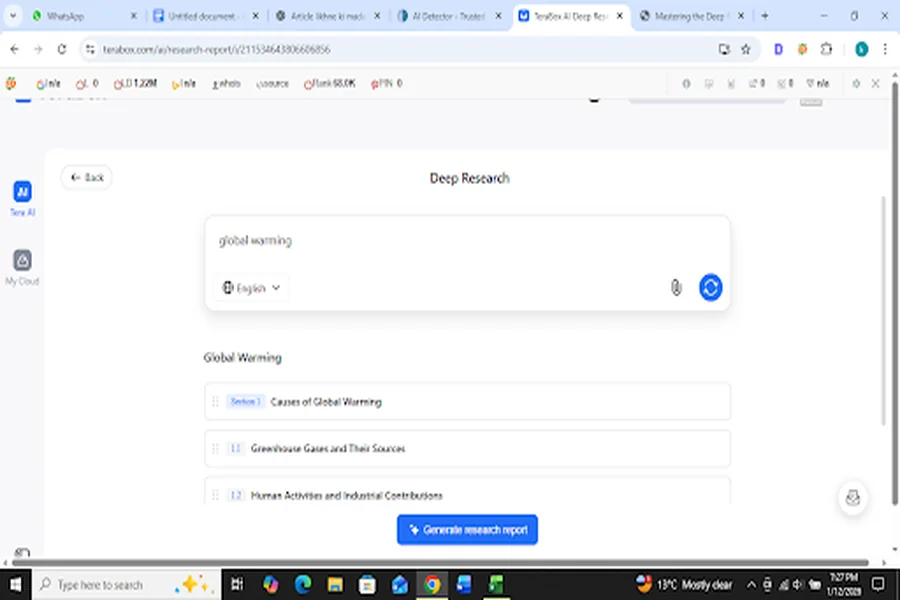
You can guide the tool by:
- entering a detailed research question
- uploading reference material
- specifying the depth you want
This helps the AI researcher stay focused.
Step 3 – Automated Source Analysis
Here’s where AI deep research shines. TeraBox:
- Reviews multiple sources simultaneously
- Filters unreliable or irrelevant content
- Identifies high-value information
This step alone saves hours of manual work.
Step 4 – Insight Extraction and Structuring
Instead of raw summaries, the tool produces:
- Thematic sections
- Key findings
- Supporting evidence
Structured output boosts understanding and usability.
Step 5 – Review, Refine and Expand
Users remain in control. They can:
- Adjust focus
- Request deeper analysis
- Explore related angles
This collaborative process ensures both efficiency and depth for research..
Pro Tips to Make Your AI Research Even Better
Using AI for research works best when it feels like a joint effort rather than a handoff. Results tend to be much stronger with thoughtful human involvement plus help from the AI, not just all one or the other.
Don’t Skip the Human Review Step
The most advanced AI researcher still wants oversight from humans. While AI can intake facts fast, it does not “get” the setting as people do. That is why output review care is key.
Take time to:
- Read through the results with attention
- Question claims that seem unclear or too broad
- Adjust tone, emphasis, or direction where needed
This review step helps ensure your work remains accurate, personal, and aligned with your original research goals. It also protects the authenticity of your final output.
Combine AI Depth with Human Judgment
AI is great at finding patterns and putting huge facts together. However, knowing what is truly important still falls under human skills.
AI can help you:
- Organize complex information
- Identify recurring themes
- Surface connections you may have missed
Your role is to:
- Interpret what those patterns mean
- Decide which ideas deserve focus
- Build arguments and conclusions based on understanding
This balance keeps research thoughtful rather than mechanical and is especially important in academic and professional settings.
Use AI for Structure, Not Final Authority
One of the smartest ways to use AI in research is to let it handle structure. This includes things like:
- Creating outlines
- Grouping ideas by theme
- Building comparison frameworks
These elements provide a strong foundation. But from you must come the reasoning, the perspective, and the final judgment. When AI helps with structure in one hand and insight from humans on the other, a paper turns out to be fully filled, believable, and truly one’s own work.
External Learning Resources from TeraBox
For readers who want to go deeper, TeraBox’s blog offers useful insights, such as:
- “How AI Research Tools Improve Structured Thinking”
- “Using AI Responsibly in Academic Research”
Conclusion: Using Research with AI the Smart Way
Modern research is not about working long hours but about having the right tools to work smart. Applying AI in research enables individuals to maintain depth and accuracy at the highest level possible despite dealing with complex topics.
TeraBox Deep Research proves itself in deep analysis and organization, offering both structure and insights at a detailed level that can be used in reporting,
Knowing what tool to use and when makes AI stop being overwhelming and starts making it supportive. Thoughtful use brings about clarity, saving of time, improvement in the quality of research without replacing human thinking.