

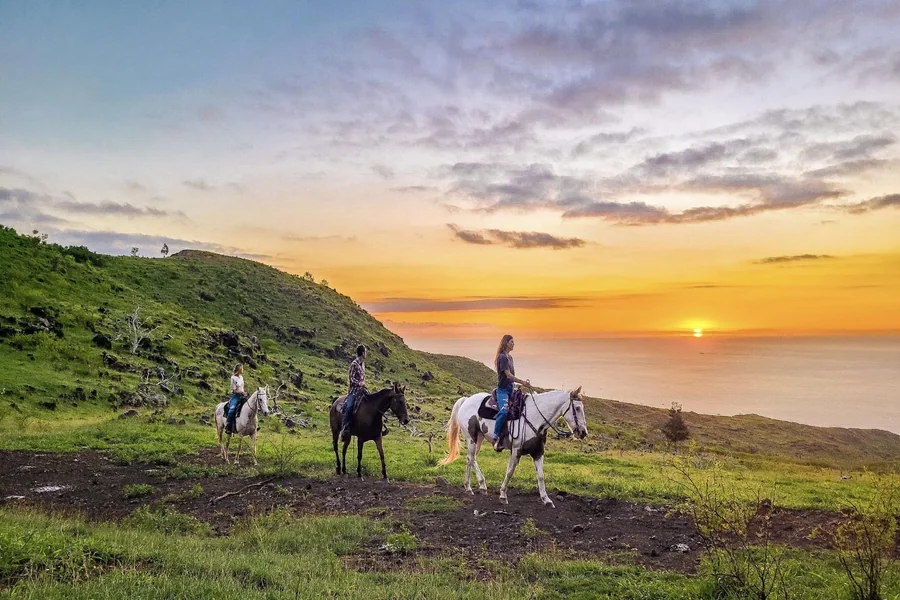
Trail riding occupies a strange position in the world of outdoor recreation. It’s physical, but not exhausting. It gets you outdoors, but you’re not doing all the work. It requires focus, but not the grinding concentration of a technical sport. The result is something relatively rare: an activity that genuinely quiets the mind while still engaging the body.
If you’ve never been on a horse outside of a tourist attraction, the idea of trail riding as a relaxation strategy might seem counterintuitive. Horses are large, occasionally unpredictable animals. There’s a learning curve. But the same is true of surfing or skiing, and nobody questions whether those activities can be meditative once you get past the initial anxiety. Trail riding is similar — the difficulty front-loads into the first hour, and what’s on the other side is genuinely hard to replicate.
What Makes Trail Riding Different From Other Outdoor Activities
Most outdoor activities put you in charge of forward motion. Hiking, cycling, running, kayaking — your legs or arms are the engine. Trail riding doesn’t work that way. The horse moves. You adapt. That shift in agency sounds minor until you experience it, and then it changes everything.
When you’re not responsible for locomotion, attention moves outward — to the landscape, the rhythm of the animal, the sound of hooves on dirt. Psychologists studying attention restoration theory, developed by Rachel and Stephen Kaplan at the University of Michigan in the 1980s, describe this effortless outward attention as a core component of mental restoration. Natural environments already provide it. Riding through one while being carried by another living creature amplifies it.
Equine-assisted therapy has been studied for decades. A 2015 study in the Journal of Equine Veterinary Science found measurable cortisol reductions after horse-grooming sessions alone. Riding produces the same effect, compounded by movement and fresh air. Most first-time trail riders notice a shift in mood within the first 20 minutes on the trail.
The Sensory Experience of Being on a Horse Outdoors
Describing what trail riding feels like is harder than it sounds, because the experience is mostly non-verbal. The rhythm is the obvious entry point — a horse at a walk produces a four-beat gait that’s slightly hypnotic, steady, repeating, close to resting heart rate. Your body absorbs it rather than fights it. Most riders find themselves synchronizing to it without consciously trying.
The elevation matters too. On horseback you’re sitting roughly 5 to 6 feet above the ground. That changes your relationship to the landscape. Trails that would feel narrow on foot feel open from the saddle. Ridgelines reveal themselves at a pace you can actually absorb.
The smell of the horse, the creak of the saddle, the warmth through your legs — sensory inputs specific to this activity and nothing else. They tie you to the present moment more effectively than any mindfulness app. Trail riding doesn’t ask you to be present. It just makes it difficult to be anywhere else.
Why Trail Riding Works as Stress Relief
Stress relief from outdoor activities generally falls into two categories: distraction and physiological reset. Running distracts you and triggers endorphins. Meditation produces physiological changes but requires mental effort many people can’t sustain. Trail riding works on both tracks simultaneously, without requiring you to pursue either.
The physiological effects are well-documented. Rhythmic movement activates the parasympathetic nervous system — the “rest and digest” branch that counteracts the stress response. Riding at a walk keeps your body in continuous gentle motion, closer to rocking than to exercise. The mechanism that calms infants in a moving car scales up, surprisingly well, on adults on horseback.
The cognitive load is the other piece. Trail riding requires just enough attention to prevent rumination — you stay aware of the horse, the terrain, nearby riders — but not enough to become stressful. Psychologists call this the “soft fascination” state: engaged enough to hold attention, low-stakes enough that it doesn’t generate stress. Watching a campfire works the same way. Trail riding produces it more reliably, for longer.
The Social Dimension: Why Group Rides Work
Trail riding suits groups in a way many outdoor activities don’t. The pace is conversation-friendly. Side by side or in loose single file, the dynamic is different from sitting across a table — less confrontational, more open. Conversations on horseback tend to go somewhere.
For people who find traditional social settings draining, riding offers useful structure: shared attention on the horses and the environment reduces the pressure of continuous engagement. You can ride quietly for ten minutes and it isn’t awkward. Families with teenagers, couples, friend groups — trail riding tends to produce easy, unhurried togetherness that’s difficult to manufacture elsewhere.
Solo riding intensifies the meditative quality. Without conversation, some riders describe regular trail time as the closest they’ve come to actual meditation — not because they’re trying, but because the conditions make it nearly unavoidable.
What to Expect on a Trail Ride
A guided trail ride — the most common entry point for beginners — involves a brief orientation, a horse matched to your experience level, and a guide who manages the pace. First-time riders sometimes arrive expecting a petting zoo or a rodeo. It’s neither.
The first 15 minutes are the adjustment period. The horse is bigger than expected. The saddle is higher than you’d like. Your body isn’t sure what to do with the movement. This passes quickly, and by the time the trail opens up and the guide settles into a relaxed walk, most riders have stopped thinking about the mechanics and started looking around.
A two-hour ride at a walk covers five to eight miles, depending on terrain — enough to feel like you’ve been somewhere, without the physical demands of a full day hike. Guided rides in natural settings — canyon trails, coastal paths, mountain foothills — offer landscapes that feel genuinely different from the same route on foot.
What to Wear and Bring
Closed-toe shoes or boots are non-negotiable — you need a heel to keep your foot from sliding through the stirrup. Long pants reduce saddle friction, which matters more than most beginners expect. Sun protection matters on exposed trails. Everything else is secondary; most outfitters provide helmets and can work with whatever you’re wearing.
Trail Riding in Southern California: Why the Setting Matters
Where you ride shapes the experience as much as the riding itself. Southern California offers an unusual range of trail environments within a compact geography — coastal bluffs, high desert, mountain foothills, canyon country — and the quality of the light and the scent of chaparral are specific to this part of the world.
San Diego County surprises people who think of the region primarily as a beach destination. The backcountry east of the coast — Rancho Santa Fe, Del Mar Mesa, the San Dieguito River Park, the mountains around Julian — offers terrain that bears no resemblance to the coastline 20 miles west. For anyone interested in horse riding San Diego, the variety within the region is one of the real draws: oak woodland one weekend, high desert the next, without driving more than an hour.
Winter rides in the San Diego backcountry, when December rains turn the hills green, are often the best of the year. Less crowded, better temperatures, and landscapes that look like Ireland for about six weeks before the dry season turns them gold.
How Trail Riding Compares to Other Relaxing Outdoor Activities
The usual comparison set includes hiking, fishing, kayaking, and cycling. Trail riding shares qualities with all of them while doing a few things none of them quite manage.
Hiking is trail riding without the horse — similar environments, similar pace, but you carry yourself and attention splits between physical effort and scenery. Fishing has the soft fascination quality but anchors you in one spot. Kayaking requires continuous effort. Cycling is faster and more physically demanding than most people want when relaxation is the actual goal.
Trail riding sits at an unusual intersection: you move through landscape at a pace suited to actually observing it, with an animal as both vehicle and companion, in conditions that suppress rumination without requiring mental effort. For people who have been curious but haven’t committed, the barrier is lower than it looks. Searching for trail riding near me and booking a guided first ride is one of the lower-risk ways to try something new outdoors — no equipment purchases, no technical skills required before you can experience the actual thing.
Trail Riding as a Regular Practice
People who ride regularly talk about it differently than first-timers. Single visits get described in terms of the horse, the scenery, the novelty. Regular riders talk about it the way others talk about morning runs — as something built into their lives because the absence of it is noticeable.
That shift happens because the benefits compound with familiarity. As the mechanics become automatic, the meditative quality deepens. You stop thinking and just ride — which is when real restoration happens. Early sessions are about surviving the experience; somewhere past that threshold is where it becomes genuinely restorative.
Trail riding is one of the most relaxing outdoor activities precisely because it doesn’t try to be relaxing. It puts you on a horse in a landscape and lets the situation do what it does — which turns out to be more effective than activities specifically designed for relaxation, and considerably more interesting.